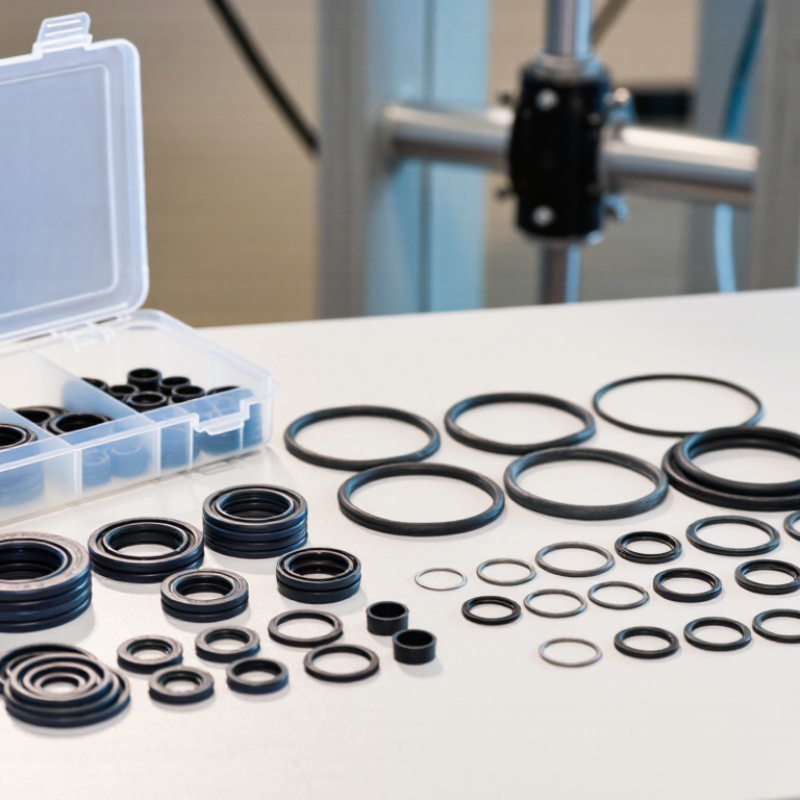
Choosing the right Nbr Seal Kit in 2026 requires more than comparing prices. Global buyers must examine material quality, sealing performance, and supplier reliability. A kit that looks suitable online may fail under heat, pressure, or repeated movement. Small details matter.
Nitrile rubber, commonly called NBR, performs well with many mineral oils, fuels, and hydraulic fluids. However, it is not ideal for every chemical or temperature range. Buyers should check the manufacturer’s compatibility chart before approving an order. A typical evaluation includes operating temperature, pressure, shaft speed, media exposure, and storage conditions. Dimensions must also match the original seal profile. One millimeter can matter.
Reliable suppliers should provide traceable batch information, technical datasheets, inspection records, and clear packaging details. This evidence helps purchasing teams compare factories fairly across different countries. It also reduces confusion during customs clearance and quality inspections. Certifications can support confidence, but they should be verified rather than accepted blindly. That part is often overlooked.
This guide examines practical selection criteria for the 2026 market. It considers standard kits, custom requirements, replacement intervals, and total ownership cost. Experienced maintenance teams know that the cheapest kit may create expensive downtime. Still, no single product suits every machine. Application data remains essential. Some recommendations may need revision after field testing, especially where temperature cycles, unusual fluids, or long storage periods are involved. A careful buyer should question assumptions, request samples, and confirm performance before placing a large global order.
2026 Best NBR Seal Kit for Global Buyers?
NBR seal kits rely on more than a rubber name. NBR, or nitrile rubber, balances oil resistance, wear resistance, and cost. Its acrylonitrile content changes performance. Higher content improves oil resistance but may reduce low-temperature flexibility. Temperature limits also depend on the compound, not only the NBR label. This detail is often missed.
ASTM D2000 helps specify rubber performance through hardness, tensile strength, elongation, heat aging, compression set, and fluid resistance. It is a material classification system, not a complete guarantee for every application. ISO 3601 focuses on O-ring dimensions, tolerances, and quality levels. Confirm the required series, cross-section, and acceptance class before purchasing. A kit can look correct while using the wrong size.
Tips: Measure the groove and old seal with clean tools. Check the batch number, production date, storage history, and test documentation. Match the compound to oil type, pressure, temperature, and movement. Do not assume black rubber means identical performance. In real maintenance work, rushed measurements cause many leaks. I would also recheck compressed seals, because they can hide an incorrect cross-section. Supplier documents should support the stated ASTM and ISO requirements. Still, independent inspection may be necessary when failure affects safety or costly equipment.
Choosing an NBR seal kit starts with its service rating, not the number of pieces. A practical kit should cover temperatures from −30 to 120°C. However, this range is only a reference. Actual performance depends on oil type, pressure, speed, and exposure time.
Hardness also changes sealing behavior. A 70 Shore A seal usually handles moderate compression and uneven surfaces well. An 80 Shore A compound can resist extrusion more effectively under higher pressure. At 90 Shore A, installation becomes less forgiving. Sharp grooves, dry assembly, or poor alignment may damage the sealing lip. Small details matter.
Check the complete hardness range, not only one advertised value. Ask for batch test records, dimensional tolerances, compound identification, and aging results. Reliable suppliers should explain how samples were tested.
Field experience helps here. I have seen kits pass a basic temperature check but swell after prolonged contact with certain hydraulic fluids. That result was disappointing, but useful.
Review backup rings, O-rings, wipers, and storage dates together. A mixed kit may include parts with different hardness levels. That can complicate maintenance. Measure the groove before ordering. A seal that looks correct may still leak because of excessive compression or insufficient squeeze. Specifications can guide the decision, but they cannot replace a real fit check.
For global buyers, the best NBR seal kit in 2026 is not simply the cheapest option. It needs a traceable compliance file. REACH requires communication about substances of very high concern when applicable. RoHS applies mainly when seals are supplied for electrical or electronic equipment. Do not apply RoHS blindly. The European Chemicals Agency’s 2023 REF-10 enforcement project screened 2,407 products and found about 18% non-compliant. The figure is not specific to NBR kits, but it shows a real purchasing risk: paperwork may hide material gaps. Short records fail.
Food-contact applications require closer control. FDA 21 CFR 177.2600 sets extractable limits for repeated-use rubber articles. EU Regulation 1935/2004 also requires materials to avoid harmful migration and unacceptable changes to food. A reliable kit file should identify the exact compound, hardness, temperature range, batch number, and curing date. Request extraction or migration reports linked to that formulation. Generic “FDA compliant” wording is weak evidence. The European Commission’s 2024 Safety Gate report recorded 4,137 alerts, with chemical risks among the leading concerns. This reinforces the value of documented testing. NBR performs well against oils, but ozone, sunlight, and excessive heat can shorten service life. I would still question any certificate lacking test conditions, laboratory details, or batch traceability.
| Evaluation Dimension | Applicable Requirement | Recommended NBR Seal Kit Specification | Required Documentation or Verification | Global Buyer Acceptance Point |
|---|---|---|---|---|
| Base Elastomer | Nitrile butadiene rubber, commonly identified as NBR or nitrile rubber. | Use a clearly identified NBR compound with a defined acrylonitrile content, hardness grade, cure system, and batch traceability. | Material specification, compound identification, technical data sheet, and batch or lot record. | Compound identity and production traceability must be documented before approval. |
| Oil and Fuel Resistance | NBR is generally selected for resistance to mineral oils, greases, and many petroleum-based fluids. | Confirm compatibility with the actual fluid, concentration, pressure, temperature, and exposure duration. Do not use generic NBR resistance claims as the sole qualification. | Fluid-compatibility chart plus application-specific immersion or seal-performance test data where required. | Acceptance should be based on measured volume change, hardness change, leakage, and dimensional stability. |
| Temperature Capability | Typical NBR service limits depend on compound formulation, hardness, geometry, and operating conditions. | A commonly used general design range is approximately -30 °C to +100 °C; some formulations may provide different limits. | Compound-specific temperature rating, aging test results, and application validation. | Use the supplier’s compound-specific limits rather than applying one temperature range to every NBR seal. |
| REACH | Regulation (EC) No 1907/2006. Requirements may include substance restrictions and communication of Substances of Very High Concern (SVHCs). | Finished seals and kit components should be reviewed for restricted substances and SVHC communication obligations applicable to the supplied articles. | REACH declaration, current SVHC screening or analytical statement, and supply-chain substance information when applicable. | Supplier declaration required |
| RoHS | Directive 2011/65/EU and applicable amendments restrict specified substances in electrical and electronic equipment. | RoHS status is relevant when the seal kit is supplied as part of, or for use in, covered electrical or electronic equipment. It is not automatically applicable to every standalone seal. | RoHS declaration and, where requested, material composition or test evidence for restricted substances. | Confirm product scope |
| FDA 21 CFR 177.2600 | U.S. regulation for rubber articles intended for repeated use, including extractives limits under specified test conditions. | Use only a formulation specifically developed and documented for the intended food-contact application. General industrial NBR must not be represented as FDA-compliant without evidence. | Food-contact compliance declaration, formulation or raw-material control statement, and applicable extraction test report. | Application-specific evidence |
| EU 1935/2004 | Framework Regulation (EC) No 1935/2004 for materials and articles intended to come into contact with food. | Food-contact suitability must be assessed for the intended food type, contact conditions, temperature, duration, and migration risk. | Declaration of compliance where applicable, migration or overall-migration assessment, traceability information, and conditions of use. | Food-contact assessment required |
| EU Food-Contact GMP | Regulation (EC) No 2023/2006 requires good manufacturing practice for materials and articles intended for food contact. | Production should be controlled to prevent contamination, mix-ups, and loss of traceability during compounding, molding, trimming, cleaning, and packing. | Quality-management records, manufacturing controls, hygiene procedures, and batch traceability documents. | Verify manufacturing controls for food-contact orders. |
| Dimensional Accuracy | Seal dimensions must match the applicable drawing, groove design, and tolerance requirements. | Specify inside diameter, outside diameter, cross-section, profile, tolerance, flash limits, and allowable deformation. | Approved drawing, dimensional inspection report, sampling plan, and calibrated measurement records. | Critical dimensions must be verified by lot or according to the agreed inspection plan. |
| Hardness | Elastomer hardness is commonly reported as Shore A in accordance with an applicable hardness-testing method. | Define the target hardness and tolerance, for example 70 Shore A ± 5 Shore A, only when suitable for the seal design. | Hardness test report, test method, sample conditioning, and lot identification. | Hardness must be confirmed on representative production samples. |
| Compression Set | Compression set indicates the material’s tendency to retain deformation after compression and thermal exposure. | Select a compound and design that provide acceptable sealing force retention at the actual temperature and service duration. | Compression-set test report using the agreed standard, temperature, duration, specimen type, and acceptance limit. | Lower compression set is generally preferred for long-term static sealing, but the limit must be application-defined. |
| Peroxide or Sulfur Cure | Cure chemistry affects heat resistance, compression set, chemical compatibility, and extractables. | Specify the cure system when it influences food-contact status, temperature performance, or compatibility with the operating medium. | Controlled formulation record, change-control declaration, and relevant physical or extractables testing. | Any formulation change should require prior notification and requalification when relevant. |
| Surface and Visual Quality | Sealing surfaces should be free from defects that could create leakage or contamination. | Control flash, mold marks, cuts, cracks, blisters, inclusions, porosity, sticking, and particulate contamination. | Visual inspection standard, defect limit samples, inspection records, and cleanliness procedure. | Define visual acceptance criteria before mass production. |
| Kit Configuration | A seal kit may contain multiple seal profiles, backup rings, washers, or installation accessories. | Each component should have a part number, material designation, quantity, revision level, and installation position. | Bill of materials, packing list, component identification, assembly drawing, and revision-controlled instructions. | Mixed-component kits should include clear identification to prevent installation errors. |
| Packaging and Storage | Elastomer storage conditions influence aging, ozone exposure, deformation, and contamination risk. | Package seals to protect them from direct sunlight, ozone-generating equipment, heat, moisture, and mechanical deformation. | Storage instruction, packaging specification, production date or lot code, and shelf-life statement based on the compound and packaging method. | Use first-in, first-out inventory control and inspect aged stock before installation. |
| Traceability | Traceability supports regulatory communication, product recalls, nonconformance investigation, and change control. | Every kit should be traceable to the material batch, molding batch, inspection record, packing date, and applicable specification revision. | Lot code, certificate of conformity, inspection report, and retained production records. | Full lot traceability is recommended for global distribution. |
| Change Management | Changes to formulation, raw materials, tooling, manufacturing site, or critical process parameters can affect compliance and performance. | Require advance notification for changes that may alter dimensions, extractables, chemical resistance, hardness, or regulatory status. | Change-notification procedure, revised declarations, requalification plan, and updated technical documents. | No unapproved material or process substitution. |

2026 Best NBR Seal Kit for Global Buyers?
Selecting an NBR seal kit starts with accurate sizing, not the number of pieces inside the box. ISO 3601 tolerances help control inside diameter, cross-section, and roundness. They do not replace correct gland measurements. Measure the shaft, bore, groove depth, and expected movement. A seal can meet the standard and still fail in a poorly designed groove. That detail is often missed.
Pressure changes the selection. At low pressure, a correctly fitted NBR O-ring may perform reliably. Higher pressure can force the seal into clearance gaps, causing nibbling or extrusion. Smaller gaps, suitable hardness, or backup rings can reduce this risk. Temperature also matters. Many NBR compounds operate near -30°C to 100°C, but the actual range depends on formulation and exposure time. Short tests can mislead.
Media compatibility needs practical verification. NBR commonly suits mineral oils, hydraulic fluids, and some fuels. It usually performs poorly with strong ozone exposure, many oxygen-rich fluids, and selected aggressive chemicals. Check the compound’s resistance data, then confirm it with immersion testing at operating temperature. Record hardness, swelling, compression set, and visual changes. Keep traceability documents with every kit. Global supply adds another concern: packaging may age before installation. I have seen correct-sized seals fail after storage in heat and sunlight. The specification was right; the handling was not. Recheck assumptions before approving large quantities.
2026 Best NBR Seal Kit for Global Buyers?
For global buyers, the best NBR seal kit is not defined by packaging alone. Supplier due diligence should begin with the quality system behind every molded ring, backup seal, and lubricant-free component. Ask for a current ISO 9001 certificate, its certification body, covered production site, and scope. A certificate with an unclear scope raises questions. Verify it independently when possible.
Batch traceability must reach the material compound, molding date, operator, cavity, and inspection results. On a practical audit, request one sealed kit and trace it backward. The supplier should identify the compound approval, hardness result, dimensional report, and packing record within minutes. That speed matters during a field complaint. Labels should match purchase orders and internal lot numbers.
PPAP records show whether the supplier controls change, not merely production. Review the control plan, process flow, dimensional study, material test results, capability data, and approved samples. For NBR seals, check hardness, tensile performance, compression set, and resistance to the stated fluid and temperature range. Do not accept copied reports without raw data. I have seen neat files hide weak sampling plans. That is a warning. A stronger review includes a remote process walk-through, retained samples, and written change notification terms. Some suppliers may resist. That hesitation deserves documented follow-up.
Supplier Due Diligence: ISO 9001, Batch Traceability, and PPAP Records
The chart presents a practical 100-point supplier due-diligence model for NBR seal kit sourcing. ISO 9001 certification, batch traceability, material records, process controls, measurement evidence, and PPAP documentation are weighted according to their importance in quality assurance and production approval. Buyers should verify current records rather than relying only on certificates or declarations.
By continuing to use the site, you agree to the use of cookies. more information
The cookie settings on this website are set to "allow cookies" to give you the best browsing experience possible. If you continue to use this website without changing your cookie settings or you click "Accept" below then you are consenting to this.